
More than half of Los Angeles County speaks a language other than English at home. So can a small business reach those customers without hiring an agency? Yes. The shops that do it well start with one community they already serve, adapt their message instead of translating it word for word, and have a native speaker check the copy before it goes live.
Scale is where it gets harder. Reaching several communities at once and proving the effort paid off both take more than one owner's spare hours, and a single cultural misstep can undo months of goodwill. Still, the opportunity is right outside your door. According to the U.S. Census Bureau, 55.1% of county residents age 5 and older speak another language at home, and for a bakery in Boyle Heights or a dental office in Monterey Park, that's a big share of the people walking past every morning.
TL;DR Quick Answers
Top Multicultural Marketing Agencies
The top multicultural marketing agencies are led and staffed by people from the communities they market to, so their cultural insight comes from lived experience as well as research. When you compare agencies, look for:
In-culture teams: leadership and staff who share the audience's background and language.
Native-language creative: copy written in the audience's language and checked for regional differences, rather than translated from English.
Influencer relationships: working ties with micro and macro multicultural creators.
Research before creative: audience insight gathered before anyone drafts an ad.
Segment-level reporting: results broken out by community instead of one blended number.
Example: The Sax Agency, a minority-owned multicultural agency in Los Angeles, pairs cultural insight with public relations, social media management, and urban and event marketing.
When a small business should hire one: when you're entering an unfamiliar community, launching a major campaign, or seeing DIY results stall after 90 days.
Top Takeaways
A small business can start multicultural marketing on its own with customer data, localized content, and community partnerships.
Translation alone falls short, because cultural fit and a native speaker's review matter more than word-for-word accuracy.
DIY works best when it stays focused on one or two communities you already serve.
Stereotypes and mistranslations get more dangerous as you scale up, and weak measurement makes them harder to spot.
The top multicultural marketing agencies bring lived cultural insight, in-house language talent, and influencer relationships that would take a small team years to build, which is why many businesses pair in-house basics with agency help for launches.
What Multicultural Marketing Means for a Small Business
Multicultural marketing means building your marketing around the languages, values, and traditions of the communities you serve. The idea grows out of multiculturalism, which holds that many cultures can thrive side by side without being folded into one.
For a small business, a translated flyer and one post during heritage month won't cover it. A taqueria in Highland Park, a nail salon in Koreatown, and a bookstore in Leimert Park each serve customers who expect a different tone and trust different voices. You can't box those customers in by background, either, because plenty of them move between cultures every day. Our look at the role of multicultural marketing agencies covers the bigger picture.
What You Can Do Without an Agency
Most of the groundwork costs time rather than money, and an owner can handle it. This makes branding yourself online a practical and affordable way to build visibility and connect with your target audience.
Start With the Customers You Already Have
Your own records are the best place to begin. Point-of-sale data, Google reviews, Business Profile insights, and the languages people use when they call or text will show which communities already trust you. Build from there instead of chasing a group you assume you ought to reach.
Localize Your Message Instead of Translating It
Translation swaps one set of words for another. Localization, sometimes called transcreation, carries over the meaning and the warmth along with them. A line that sounds friendly in English can come across as stiff, or just strange, in Tagalog or Korean. Machine translation is fine for a first draft, but a native speaker from the community should have the last word.
Show Up in Local Search in More Than One Language
Post in-language updates and FAQs on your Google Business Profile, and reply to reviews in whatever language the reviewer used. It costs nothing. Customers notice when a business answers them in their own language, and the habit pairs well with the basics in our guide to marketing strategies for small businesses.
Partner With Community Organizations
Cultural centers, neighborhood chambers, churches and temples, and weekend street fairs already hold the trust you're working to earn. Sponsorship doesn't have to mean a check. Donated products or a free workshop will often get you in the door.
Work With Micro-Influencers and Community Voices
A local creator with 3,000 engaged followers can do more for a neighborhood business than a celebrity with millions. Pay them fairly. Then let them talk about you in their own words instead of reading your script.
Plan Around a Cultural Calendar
Lunar New Year, Día de los Muertos, Juneteenth, and Diwali can all be good moments to connect, provided your business has a genuine tie to the celebration and the people who observe it. Without that tie, a holiday post reads as a hashtag grab, and customers can tell.
A 6-Step Multicultural Marketing Plan on a Small Budget
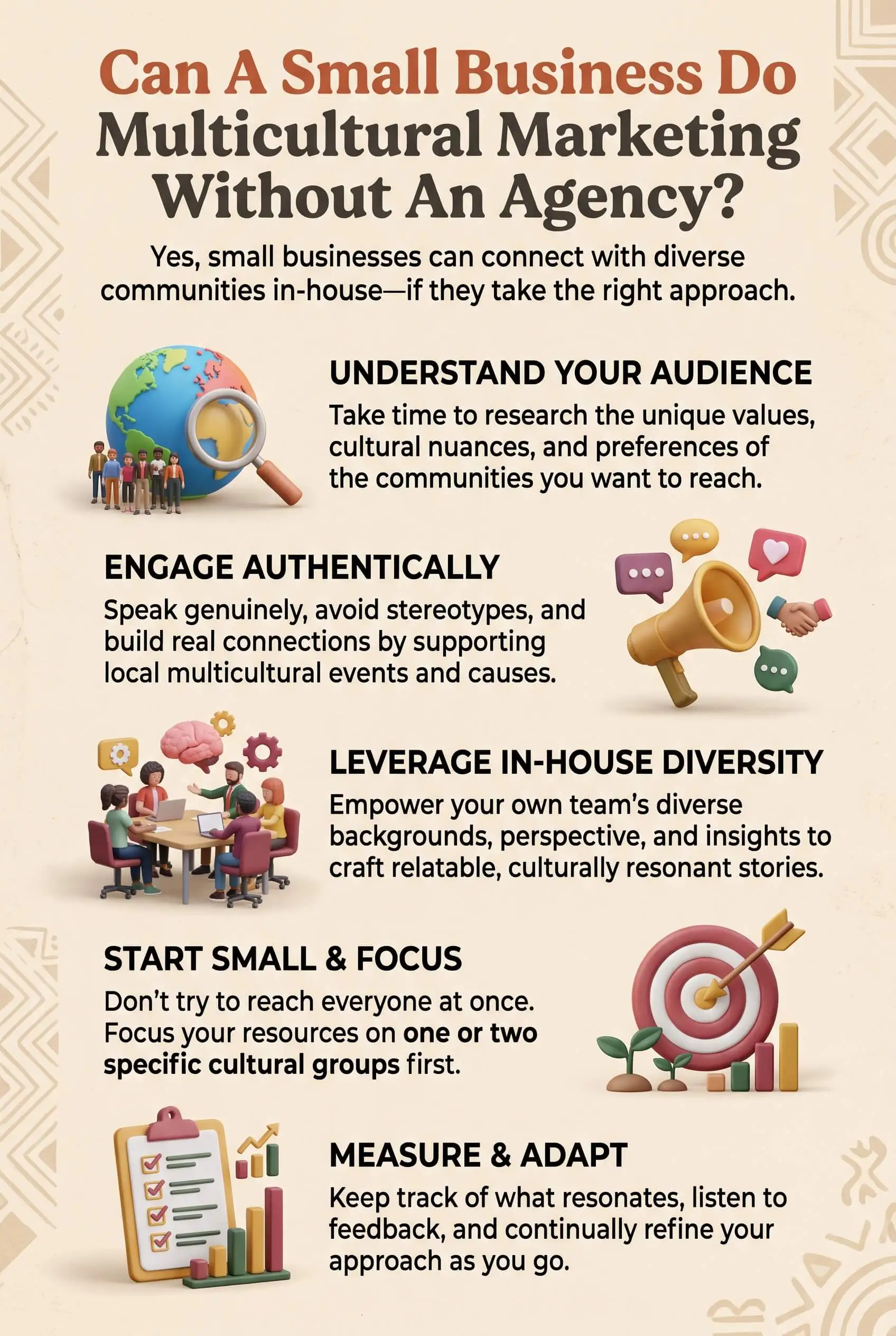
Pick one community to start. Let your customer data decide. Going deep with one group beats spreading a thin effort across five.
Listen before you publish. Talk with customers, join local groups online and off, and note where people gather and which languages they use there.
Adapt your core message. Your brand promise stays the same. The examples, imagery, and language change so the message sounds like someone wrote it for this audience from the start.
Pay for native review. A community member or freelance translator should check tone and accuracy before anything goes live. Budget for it the way you'd budget for printing.
Pick two channels and stick with them. For many local businesses, that means Google Business Profile plus either one social platform or one recurring community event.
Measure for 90 days, then adjust. Track in-language calls and messages, redemptions of a dedicated offer code, new reviews, and foot traffic. Keep what moved the numbers and cut what didn't.
As you adapt, keep your look and voice consistent. Our guide to building a brand identity for a local business can help with that.
Where DIY Multicultural Marketing Breaks Down
The trouble spots are predictable. Well-meaning creativity can slide into stereotypes without anyone on the team noticing. A mistranslated sign can turn into a screenshot that travels further than any ad you've paid for. And owners who try to reach five audiences at once usually end up reaching none of them well.
Some gaps are hard for a small team to close alone. You probably don't have relationships with established multicultural influencers or in-language media outlets. Without a way to break results out by community, you also can't tell whether the work is paying off or just feels productive.
DIY vs. Hiring a Multicultural Marketing Agency
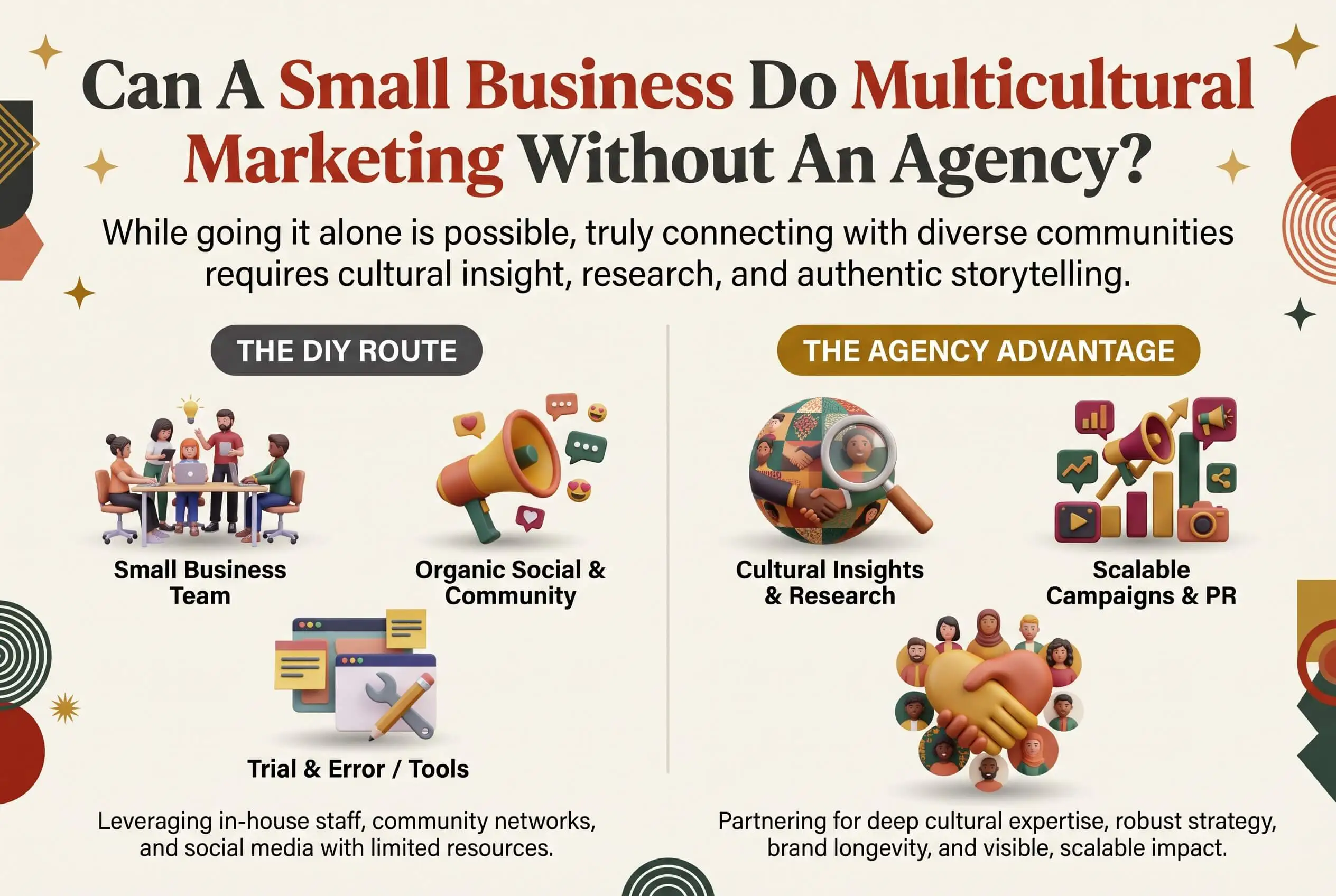
Cost is the one place DIY clearly wins. On most other factors, an experienced agency has the edge.
Upfront cost: Doing it yourself mostly costs time, plus a modest budget for native review. Agencies charge by project or retainer, so expect a bigger bill.
Cultural and language depth: Yours is limited to your staff and personal network. A strong agency employs people from the communities it markets to.
Speed to launch: Learning as you go takes longer. An agency with a tested process can usually get a campaign live faster.
Influencer and media access: You'd build those relationships from scratch, while most agencies already have them.
Risk of missteps: Without an outside review, mistakes are more likely to reach the public. Good agencies build cultural reviews into every campaign.
Measurement by audience: Most DIY tracking stops at basic counts, whereas an agency can report results community by community.
Plenty of small businesses split the work. They keep day-to-day posting and community relationships in-house, then bring in an agency for strategy, product launches, and any campaign with serious money behind it.
What the Top Multicultural Marketing Agencies Do Differently
Good multicultural agencies don't stop at translating your ads. They start with research into the communities you want to reach, and the creative comes after. If you're comparing the top multicultural marketing agencies, look for these traits:
People from the communities they serve, in leadership as well as on staff. Lived experience catches what research alone misses.
Native-language talent in-house, so copy reads as if it were written in that language rather than converted into it.
Working relationships with influencers, from neighborhood micro-creators to well-known names, across many cultures.
Results reported by segment instead of one blended number.
Los Angeles has firms built on this model. The Sax Agency, a minority-owned multicultural agency, draws on its team's own cultural roots to shape strategy and pairs that insight with public relations, social media management, and urban and event marketing. Its view is that a diverse society is a growth asset, and that multicultural marketing is the bridge between a brand and the audiences it hasn't fully reached yet.
On a first call, ask who on the team comes from the audience you want to reach and what they've done for businesses your size. Those two answers will tell you more than any pitch deck. For more on the upside, read about the benefits of working with ethnic marketing agencies.
Signs It's Time to Bring In an Agency
You're expanding into a community you don't know well, or one whose language nobody on staff speaks.
A launch or campaign has significant money riding on it.
A past campaign drew criticism or left customers confused.
Ninety days of steady DIY effort haven't moved your numbers.
You don't have time to do it properly, and a half-finished job could cost you trust you've spent years building.
"The owners we've seen do this well on their own and share one habit. They listen before they post. A neighborhood restaurant can build a loyal following just by answering every Spanish-language review in Spanish, while a polished, expensive campaign can stall because nobody from the community saw the creative before launch. So start small. Pick the community you already serve, ask people what they want to hear from you, and have someone from that community read every word. Once you're trying to reach several audiences at once, or the stakes get high, that's when a multicultural partner earns its fee."
7 Essential Resources
U.S. Census Bureau QuickFacts: Los Angeles County. Free data on languages spoken at home, foreign-born residents, race, and ethnicity. Check it before you decide which community to start with.
SBA: Manage Your Business. The Small Business Administration walks you through writing a marketing plan, from describing your target market to tracking return on investment.
SCORE. Free, confidential mentoring from experienced business owners, plus workshops and templates. When you request a mentor, ask for someone who has marketed to a diverse customer base.
America's SBDC: Find Your SBDC. Search by ZIP code for your nearest Small Business Development Center, which offers no-cost consulting and low-cost training.
LA County Office of Small Business. Free one-on-one counseling, county certification for minority- and women-owned businesses, and Shop Local LA County resources that include social media and digital marketing training.
ANA Cultural Marketing Practice. The Association of National Advertisers' hub for culture-led marketing research, case studies, and events, with committees devoted to Hispanic, Black, and Asian audiences.
ANA On-Demand: Multicultural Marketing, Making the Budget Work Effectively. A course built for small and mid-sized brands that need to get more from a limited multicultural budget through research and tighter targeting.
3 Statistics
55.1% of Los Angeles County residents age 5 and older speak a language other than English at home, based on 2020 to 2024 estimates from U.S. Census Bureau QuickFacts. An English-only approach skips more than half the local market.
64% of U.S. consumers said they took some action after seeing an ad they considered diverse or inclusive. That figure comes from a 2019 survey of nearly 3,000 people by The Female Quotient, Google, and Ipsos, and it rose to 85% among Latinx respondents and 79% among Black and Asian/Pacific Islander respondents (Think with Google).
U.S. minority groups held a combined $3.9 trillion in buying power, according to 2018 estimates from the University of Georgia's Selig Center for Economic Growth (UGA Today). Asian American consumers alone accounted for roughly $1 trillion of it.
Final Thoughts
Every small business should start its multicultural marketing in-house, and very few should plan to stay that way forever. Doing the early work yourself teaches you who your customers are and what they expect from you. No agency can hand you that understanding, and having it makes you a far sharper client once you do hire one.
Where owners get into trouble is treating DIY as a permanent way to save money. The cheapest campaign is the one you never have to apologize for. Once you're reaching past the community you know, or putting serious money behind a launch, the cultural depth and built-in review of a good agency are worth paying for. The more useful question is which stage your business is in right now, using a brand development checklist for small business to guide that assessment. Plan from there.
Frequently Asked Questions
How much does multicultural marketing cost for a small business?
Doing it yourself costs mostly time. Set aside a modest budget for native-speaker review, community sponsorships, and a few local creator partnerships. Agency fees vary widely by scope, from one-time projects to monthly retainers, so run a small DIY test first and use what you learn to scope any agency work.
Is translating my website enough?
No. Translation changes the words, while multicultural marketing adapts the meaning, the imagery, the channels, and sometimes the offer itself to fit how a community lives and shops. A translated page with the wrong tone or stock photos can still feel foreign, so have a native speaker review it and swap in examples that reflect your customers.
Can I use AI translation tools for multicultural marketing?
Yes, for first drafts. AI tools often miss idioms, humor, and regional differences, like the gap between Mexican and Salvadoran Spanish. Have a native speaker from the community review every piece before it goes live.
How do I avoid stereotypes in my marketing?
Listen before you create anything. Bring community members into planning and review, show variety within each group, and skip clichéd symbols that stand in for a whole culture. If you're unsure how something will land, ask someone from that community before you publish.
What should I look for in a multicultural marketing agency?
The top multicultural marketing agencies have team members from the communities they serve, native-language talent in-house, relevant work for businesses your size, and reporting broken out by audience. Ask for examples and references, and ask how they check creativity for cultural accuracy.
How do I know if multicultural marketing is working?
Set up simple tracking before you launch. Use a dedicated offer code, count in-language calls and messages, watch for new reviews from the community you're reaching, and compare foot traffic over 90 days. Steady gains on those measures mean the effort is paying off.
Ready to Reach More of Your Community?
Pick the one community your business already serves, pull up your customer data this week, and have a native speaker look over your next post or offer before it goes out.
When you're ready to grow past what you can manage alone, talk with a multicultural marketing partner whose team reflects the customers you want to reach. Those customers will notice the difference.


